

 Posts
Posts


On our last day in Florida we headed to Six Mile Cypress Slough Preserve in Fort Myers. While less famous than the other reserves we visited, our walk was very fruitful. The 1.2 mile boardwalk began at the Gator Pond, where we indeed saw two immature alligators. Across the pond, a wood stork landed in a tree. Double-crested cormorants rested on a platform in the pond while we spotted a common moorhen at the water's edge just a few feet from our overlook. As the sun grew hotter, we were grateful that much of the boardwalk wended through the woods. At one overlook we were amazed to watch an anhinga as it beat a fish on a branch repeatedly, probably to make it easier to swallow. An ibis landed in a tree next to a pavilion surrounded by people, oblivious to them.
It was amazing how tame all the wildlife was. While I was glad that I was not carrying my tripod and long lens (due to exhaustion) I regretted that decision when we observed a pileated woodpecker hammering at a tree just a few feet from the boardwalk. Oh, hindsight!
All in all, we spotted: Great egret; wood stork; anhinga; double-breasted cormorant; alligator; common moorhen; red-bellied and pileated woodpecker; white ibis; vultures; turtle; and a water snake. I have never been able to identify two small species in the woods. Perhaps they were warblers.
All in all, this preserve was an unforgettable experience during an amazing trip.
Saturday, March 31, 2012

Saturday, March 17, 2012
At "Ding" Darling National Wildlife Refuge
On our third day in Florida, we headed to Sanibel Island to visit J.N. "Ding" Darling National Wildlife Refuge. We had hardly entered the refuge when we spotted a tricolored heron and a white ibis nearby. The day was hot and it was tempting to stay in the shade. Unfortunately, the shade also harbored tiny black insects that attacked my arms relentlessly. Oblivious to insect repellant, they drove me into the sunshine. That was the only low point during an otherwise amazing drive.

One overlook was especially fruitful, as we observed a large group of white pelicans on a sandbank, snowy egret, hooded and red-breasted mergansers, plovers, ring-billed gull, and cormorants. Fish were jumping out of the water and crabs moved on the bottom.


One overlook was especially fruitful, as we observed a large group of white pelicans on a sandbank, snowy egret, hooded and red-breasted mergansers, plovers, ring-billed gull, and cormorants. Fish were jumping out of the water and crabs moved on the bottom.

After a couple of hours, we realized that we had only covered a quarter of the wildlife drive. We then increased our pace and stopped less frequently. Before leaving the refuge, we spotted an immature alligator and, most excitingly, an osprey nest quite close to the road.

I had never before even seen an osprey, let alone one this close. What an amazing finale to our time at "Ding" Darling! After eating a nice lunch, we were too exhausted to check out other reserves on the island. That gives us a reason to return to Sanibel Island during our next trip.
Monday, March 5, 2012
Birding in Florida 2012
Last week, we spent several days in the Fort Myers area of Florida. On the second day, we headed to Corkscrew Swamp Sanctuary. We soon learned to join groups of people with binoculars. Our first surprise was a Pileated Woodpecker in a tree next to the shelter, entirely oblivious of people.



A red-shouldered hawk perched right about the boardwalk was another awe-inspiring moment. The boardwalk was quite long, and we were not used to the excessive heat. I finally decided to pack up my tripod, only to unpack it again after a couple of minutes. That was a wise decision, because the best was yet to come:

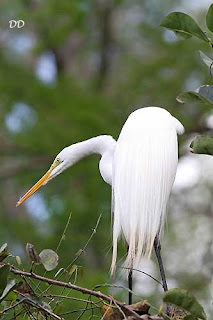
Great egrets and white ibises stalked in the shallow water right next to the boardwalk before this egret landed in a tree. It was amazing how tame all the wildlife was, including four alligator babies sunning themselves on a a log.

After six hours on the boardwalk, our tally was: red-bellied woodpecker, two pileated woodpeckers, tufted titmouse, catbird, black-and-white warbler, black-crowned night heron, swallow-tailed kite, turkey vulture, little blue heron, yellow-crowned night heron, and green heron. Besides the allegiators, we also observed zebra longwings (the state butterfly), cooters, and countless lizzards. Naturally, we also noted the vegetation, such as cypresses, pines, air plants, irises, and alligator plant. Best of all, there were no mosquitoes! It was truly a haven for nature lovers.
Friday, February 10, 2012
The Great Backyard Bird Count
I have participated in the Great Backyard Bird Count for a few years now. This year, it takes place from February 17 - 20. Anybody from beginner to bird expert can become a citizen scientist. Visit www.birdcount.org to explore past results, brush up on tricky bird IDs, or find out about local events. You can count birds for any length of time, as long as you count them at least 15 minutes a day. Once the count begins, you can submit your results online and watch the real-time uploads.
Get your binoculars and field guides ready and count birds!
Get your binoculars and field guides ready and count birds!
Friday, January 20, 2012
Bringing Nature Home
Since I am a public speaker covering backyard habitats, it is very important that I keep up on my reading about environmental topics. There are few books which have influenced my husband and me as much as Douglas W. Tallamy's "Bringing Nature Home: How You Can Sustain Wildlife with Native Plants."
This book is my bible now and I often mention it during my presentations. I can attest that we detect more and more insects in our yard, the more native plants we are planting.
Professor Tallamy discovered that our native insects cannot digest alien plants. Alien plants are any plants which were, accidentally or on purpose, introduced into the United States. These "aliens" often bring with them alien insects (e.g. the marmorated stinkbug as a recent example). Alien plants do not provide any host plants for native insects, and thus are not part of the natural food chain.
A large part of the book focuses on plants you should plant to create a healthy habitat. The back of the book lists the plants by geographical area.
I highly recommend this book to anyone who is interested in gardening.
This book is my bible now and I often mention it during my presentations. I can attest that we detect more and more insects in our yard, the more native plants we are planting.
Professor Tallamy discovered that our native insects cannot digest alien plants. Alien plants are any plants which were, accidentally or on purpose, introduced into the United States. These "aliens" often bring with them alien insects (e.g. the marmorated stinkbug as a recent example). Alien plants do not provide any host plants for native insects, and thus are not part of the natural food chain.
A large part of the book focuses on plants you should plant to create a healthy habitat. The back of the book lists the plants by geographical area.
I highly recommend this book to anyone who is interested in gardening.
Tuesday, January 3, 2012
Bird Feeding in Winter

This fall I finally decided to hang up a log that we purchased at a birding store a while ago. It has several cut-out holes to stash in food for woodpeckers and chickadees. I put some extra crunchy peanut butter in the holes and didn't have to wait long for takers. Downy and hairy woodpeckers love it and I can't refill it fast enough for them. It seems to be even more popular than the suet cake we put out.
Since winter has arrived here in western Pennsylvania with freezing temperatures and snow flurries it is particularly important to provide birds with the fuel they need to survive in this weather. Peanut butter or suet are just the ticket because of their nutritious content. You can also place nuts in the holes, but only if it isn't windy. Now sit back and enjoy the show from the warmth of your house.
Friday, December 2, 2011


Subscribe to:
Comments (Atom)
